Updated 22 September 2026
Rath Yatra is one day on the calendar and about six weeks in practice. The cycle starts with a public bath in June, runs through a fortnight when the deities are not shown at all, and closes only when they step back onto their throne.
Three chariots, built new every year
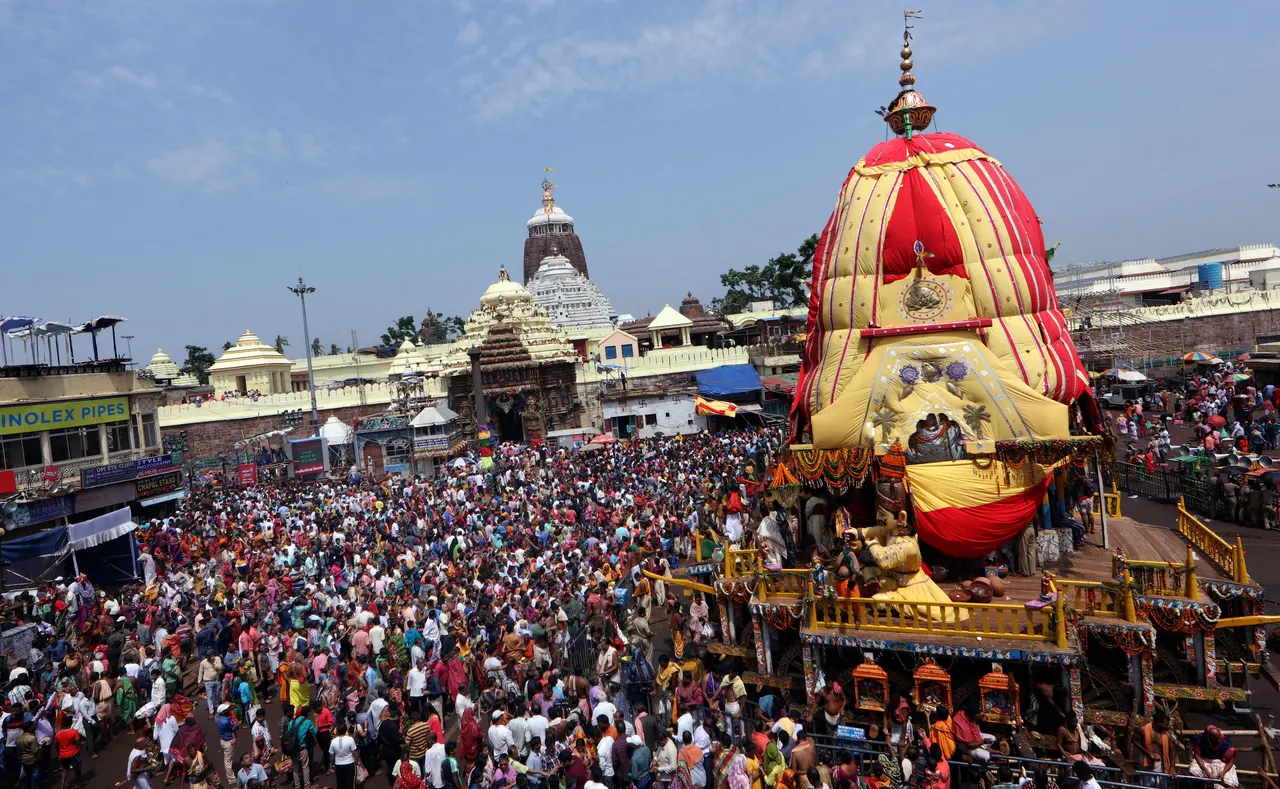
Nandighosha carries Jagannath, Taladhwaja carries Balabhadra and Darpadalana carries Subhadra. They are not stored and reused: carpenters begin from new wood every year on Akshaya Tritiya, and the finished chariots are broken up after the festival, with the timber going to the temple kitchens. The three differ in height, in the number of wheels and in the colours of their canopies, and each has its own charioteer and guardian deities.
The pulling itself is the point. The ropes are open to everybody — there is no ticket and no reserved enclosure — and the Gajapati king of Puri sweeps the chariot platforms with a golden broom before they move, a rite called Chhera Pahanra that puts the king in the position of a servant.
The fortnight when there is nothing to see
This is the part that catches visitors out. After Snana Yatra, when the deities are bathed with 108 pots of water in full public view, they are said to fall ill and go into seclusion. For about a fortnight — Anasara — the main images are not shown at all. Devotees go instead to Alarnath at Brahmagiri, about 23 km away, on the belief that Jagannath spends those days there.
Darshan resumes with Netrotsava, when the repainted eyes are revealed, and the Nabajauvana Darshan that follows is among the most crowded days of the year. Our calendar carries every date in the cycle.
The sequence, in order
| Stage | When | What happens |
|---|---|---|
| Chandan Yatra | From Akshaya Tritiya, 21 days | Representative deities go out on decorated boats on the Narendra tank; chariot building starts the same day |
| Snana Yatra | Jyeshtha Purnima | The public bath on the Snana Mandap, 108 pots of water |
| Anasara | About a fortnight after | Seclusion; no darshan of the main images |
| Netrotsava, Nabajauvana | Day before the Yatra | The eyes are revealed; darshan resumes, in enormous crowds |
| Rath Yatra | Ashadha Shukla Dwitiya | The chariots are pulled down the Bada Danda to Gundicha |
| Hera Panchami | Fifth day | Lakshmi comes to Gundicha looking for Jagannath |
| Sandhya Darshan | Ninth day | Evening darshan at Gundicha |
| Bahuda Yatra | Tenth day | The return journey, Ulto Rath |
| Suna Besha | Eleventh day | Gold ornaments on the chariots, seen free from the street |
| Adhara Pana | Twelfth day | Huge pots of sweet drink offered and then broken on the chariots |
| Niladri Bije | Thirteenth day | The deities return to the Ratnavedi and the cycle closes |
Practical notes for the Yatra days
- Suna Besha and the pulling are both watched from the Bada Danda, in the open. You do not enter the temple for either, so the entry rule does not apply — this is the one time the festival is visible to everybody.
- On and around the main day the administration shortens or suspends darshan inside the temple for the rituals. Notices come out a day or two ahead; if one is current it appears at the top of this page.
- Crowd figures in the press are round estimates rather than counts. Treat "ten lakh" and similar numbers as orders of magnitude.
- Book a room months ahead. Puri fills up completely for the Yatra week.
Nabakalebara: not soon
Every so often the wooden images are replaced in a ceremony called Nabakalebara. It happens only in a year when the month of Ashadha falls twice, which last occurred in 2015. The next such year is 2034 — this is an astronomical calculation reported in the Odia press, not a date the temple has announced. Anything you read about a Nabakalebara in 2026 or 2027 is wrong: the doubled month in 2026 is Jyeshtha, not Ashadha.